
APEX INTELLIGENCE · LEARN
Am I repeating the same mistake?
Recover the context. Skip rebuilding your history.
APEX Intelligence connects analyses, decisions and history to offer evidence-based observations. Review the cases behind them and their limits; APEX says when there is not enough history.
No cardFull access during the betaYou decide
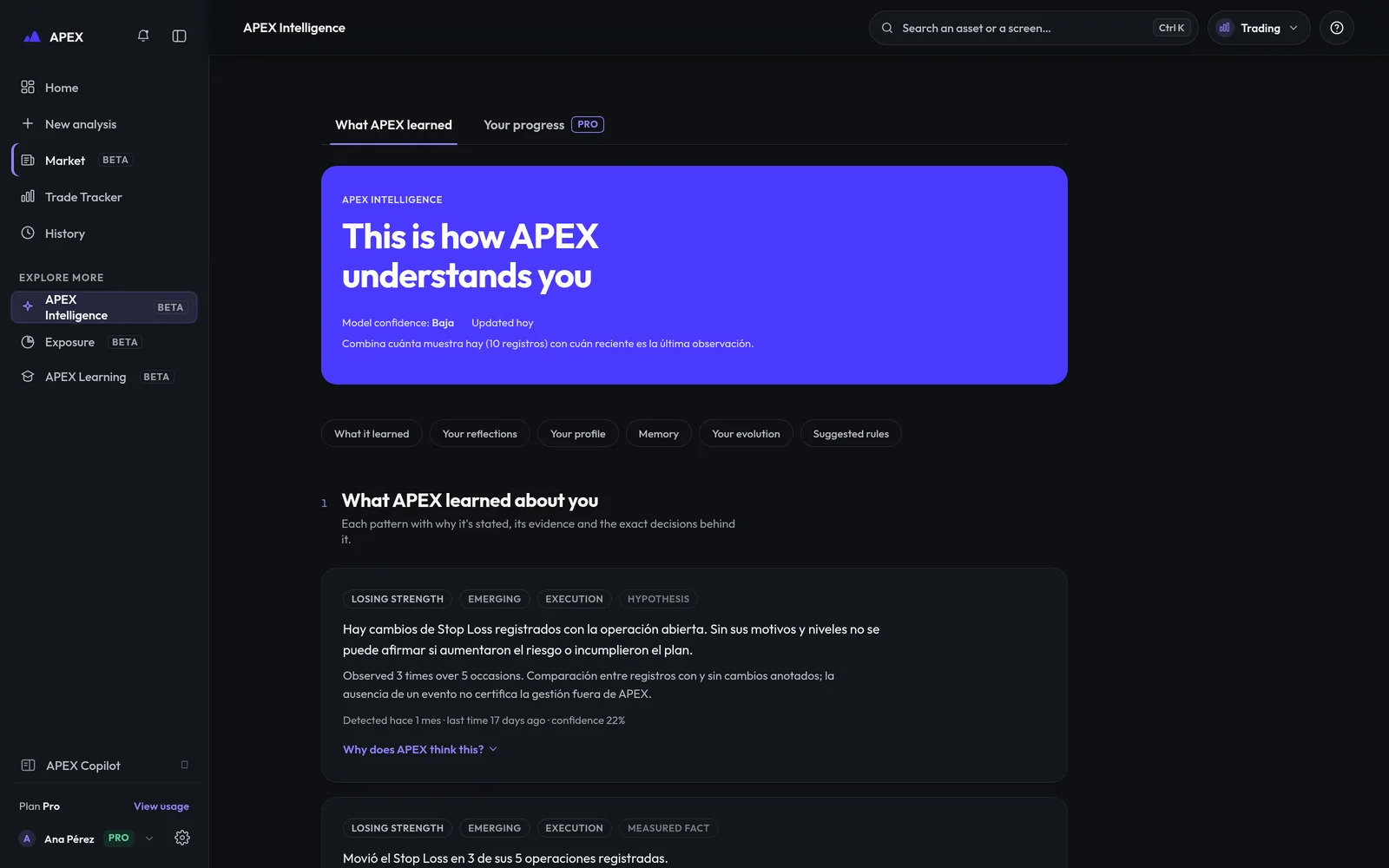 REAL CAPTURE · SAMPLE DATA
FIVE LAYERS, ONE CYCLE
From the market to your next decision.
Without the recorded result, the cycle breaks: APEX knows what it said, but not whether it was right.
- 01Market IntelligenceWhat regime the market is in, on three separate axes.See →
- 02Trade IntelligenceThesis, setup, risk, levels, context and decision, saved together.See →
- 03Trader IntelligenceRefutable hypotheses about your process, with confidence that rises or falls.See →
- 04MemoryPast results when relevant, by asset, timeframe and concepts.See →
- 05EvolutionHow much evidence a pattern has and where it is heading.See →
RULES
What Intelligence never does.
All three plans use the same model; what changes is the amount of context, not whether APEX knows you.
- No claims without a denominator: “2 of 3”. Below a minimum sample, APEX says it doesn’t have enough information.
- No total certainty: confidences have a ceiling below 1.
- No diagnoses: it speaks of hypotheses consistent with a pattern, not emotional states.
- Fail-open: if this layer doesn’t respond in time, the analysis runs as if it didn’t exist.
CONNECTS WITH
Follow the journey
Start your story with the next decision.
Memory starts with your first analysis. Patterns appear when there is evidence.
No cardFull access during the betaYou decide